



As a native French speaker who grew up in French-speaking Switzerland, I have always found it a bit odd that English borrowed “joie de vivre” from French. Joie de vivre is probably the least French attitude imaginable; the French are generally a pretty unhappy bunch, as last weekend showed. More than half a million people marched across France against the rising cost of living and declining public services. The protests had begun a month earlier with high-school students demanding better conditions in their schools. By Saturday evening, some of it had turned into violence. About 1,500 shops and businesses were looted or destroyed, around 1,000 police officers were injured, and well over a thousand people were arrested. Before that, anti-riot police had characteristically intervened with a heavy hand, and a youngster had lost his hand due to a sting ball grenade. In Limoges, the bell tower of the 19th-century town hall collapsed in flames. J.D. Vance shared footage on X. His explanation was that “Western liberals had “imported the third world into France”, and this was the result.
I don’t think there is nothing to worry about in France; there plainly is. None of what follows means the protesters have no legitimate grievances. There are serious economic problems: living costs, strained public services, and a public debt that I’ll write about in a separate post. But there is also something that is partly independent of material conditions, and it has to do with how the French see their own surroundings.Using some data, I want to emphasise two older and more French things: a deep, structural dissatisfaction with life, and a long tradition of expressing that dissatisfaction in the street.
If you spend time in Paris or the other big French cities (things look a bit different outside of them) you will find that they look very different from the apocalyptic pictures in the international media. Things mostly work. Trains run, hospitals treat people, the cafes are full. As a foreigner, you would wonder why the French complain so much about a country that is not obviously worse off than, say, the UK, where people seem far more content with broadly similar conditions. France and the UK have almost exactly the same GDP per capita. Yet across two decades of the European Social Survey, the British have consistently reported higher happiness than the French (in spite of the fact that British pensioners are eager to leave the UK, e.g for France, to really enjoy life).Yet the international media paints a grim picture of what French society is like, and to be fair, the French are not very eager to present an alternative picture.
This has been documented by French economists, most notably Claudia Senik of the Paris School of Economics. In “The French unhappiness puzzle: The cultural dimension of happiness”, she shows that the French report lower happiness than Europeans in countries of similar affluence. Her most elegant finding concerns migrants. French natives are less happy than other Europeans whether they live in France or abroad. Immigrants living in France, by contrast, are not less happy than immigrants elsewhere in Europe, but their happiness declines the longer they stay and across generations. In other words, part of French unhappiness is cultural (and contagious): something people carry with them and something newcomers gradually absorb. Senik also shows that the French are unusually pessimistic about the future, and that this gloom has a real emotional counterpart. It is not just a quirk of measurement, of how words in survey may carry different meanings.
Senik’s data stopped in 2010, so I wanted to see whether France is still a special case. Using the European Social Survey (ESS), which has asked “Taking all things together, how happy would you say you are?” on a 0-10 scale since 2002, here is how France compares with eleven other European countries in the data.
The French are less happy than their neighbours
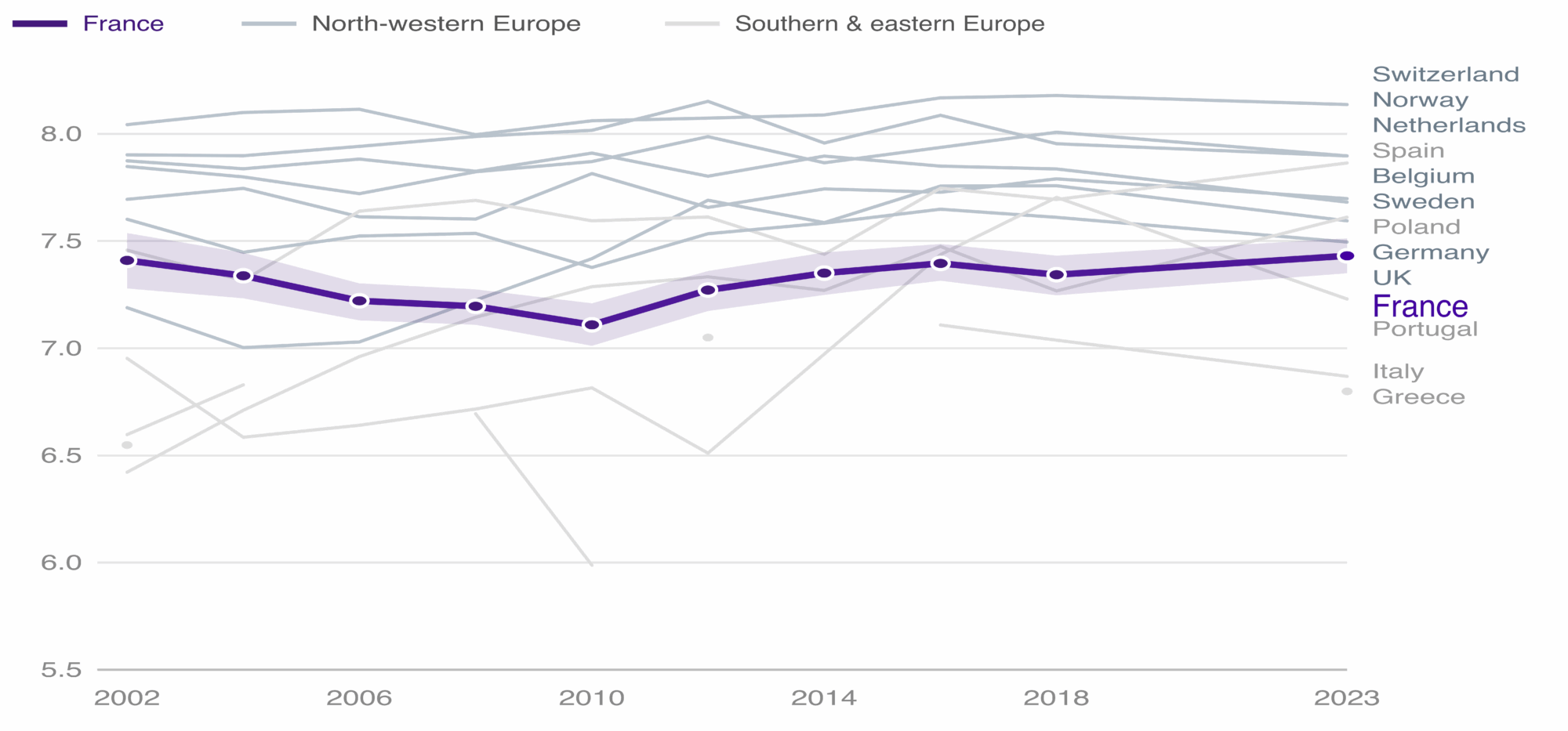
France sits towards the bottom of the pack, clearly below the rich countries of north-western Europe: Switzerland, Norway, the Netherlands, Sweden, Belgium and the UK, and, since 2010, Germany as well. The gap with that group was at its largest around 2010, at about two-thirds of a point. It has narrowed since, as French happiness has recovered somewhat, but it has not closed. In the most recent round (2023) France ranks 10th of the 13 countries, ahead only of Portugal, Italy and Greece. Those are countries where objective economic conditions are considerably harder. One caveat: the puzzle looks a bit less puzzling with the countries available to me than in Senik’s original 28-country sample. When I plot average happiness against GDP per capita, France sits only slightly below the line, and Italy and Germany sit further below it (but I think there are many common points between France and Italy). The gap is clearest in a direct comparison with France’s rich north-western neighbours, and that is the comparison the French themselves tend to make. The most striking pattern appears when you break the data down by age.
The French gap opens up in middle age
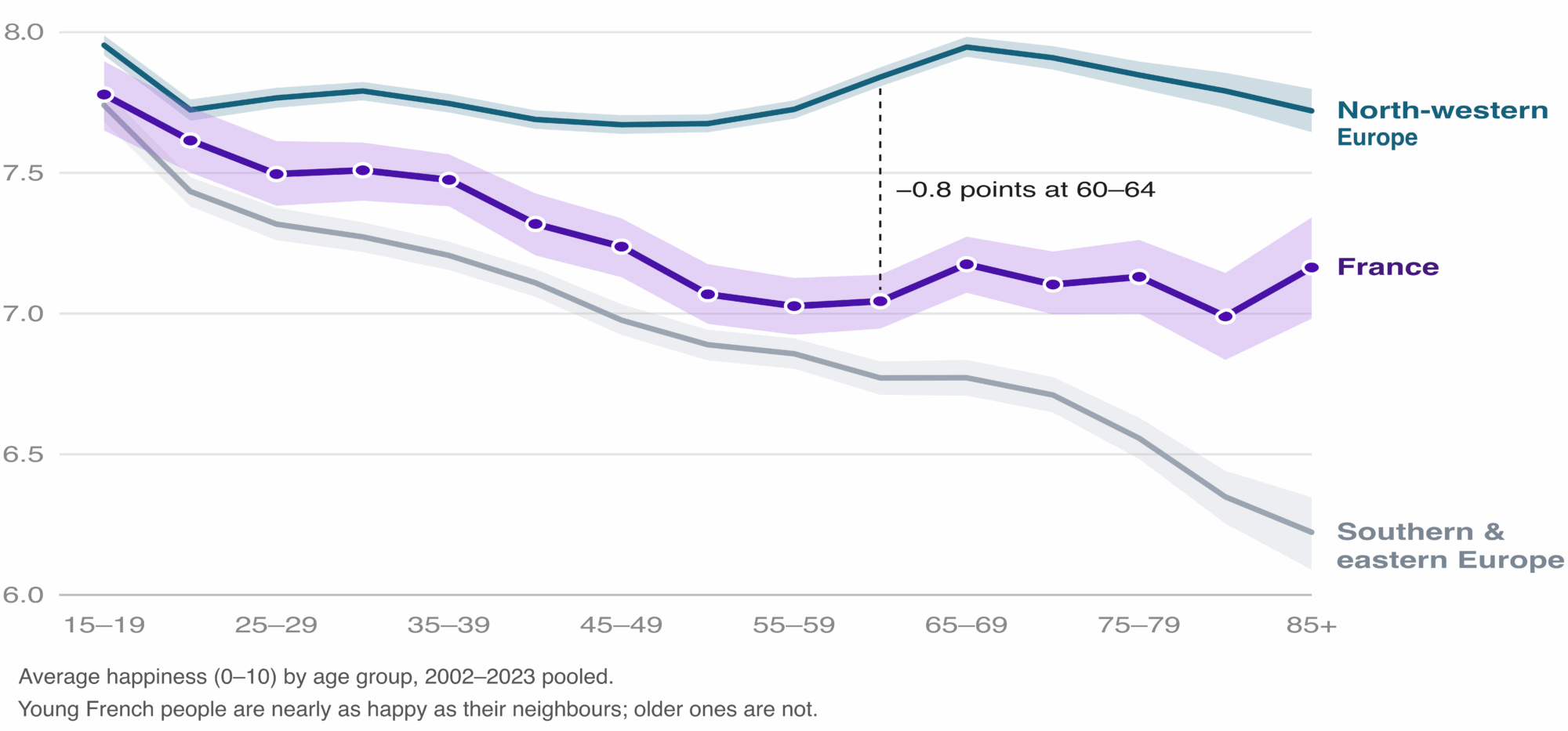
Young French people are almost as happy as their north-western European peers. Between 15 and 24, the difference is only a tenth or two of a point. The gap then opens steadily through working life. Elsewhere in north-western Europe, people get happier again from their mid-fifties, the familiar U-shape of happiness over the life course. In France this recovery barely happens. By 60-64, the French are about 0.8 points less happy than their north-western neighbours, and through middle age they sit closer to southern Europe than to the northwest. (The usual caveat applies: with pooled survey data, it is hard to separate the effects of age from those of belonging to a particular generation.)
Where does this come from? Senik highlights cultural factors, and several stand out to me. The first is high expectations. The second is a very demanding and elitist education system. About ten years ago, the Dutch broadcaster VPRO aired an excellent series, “Op zoek naar Frankrijk” (In search of France), made by a Dutchman who had lived in France for decades. Much of that gloom is learned at school, where the reigning ideology is “peut mieux faire”: “could do better”, the comment on millions of French report cards. You are never quite good enough. Perhaps this has to do with France’s past greatness. France was the dominant power in Europe and a great imperial power, and French was once the world’s lingua franca. That is no longer the case. If that period of greatness is the benchmark against which a culture measures itself, it is bound to feel that it is underperforming.
The second part of the story is how this dissatisfaction is expressed. The ESS asks people which forms of political participation they have engaged in over the previous twelve months.
The French take to the streets, not to politicians
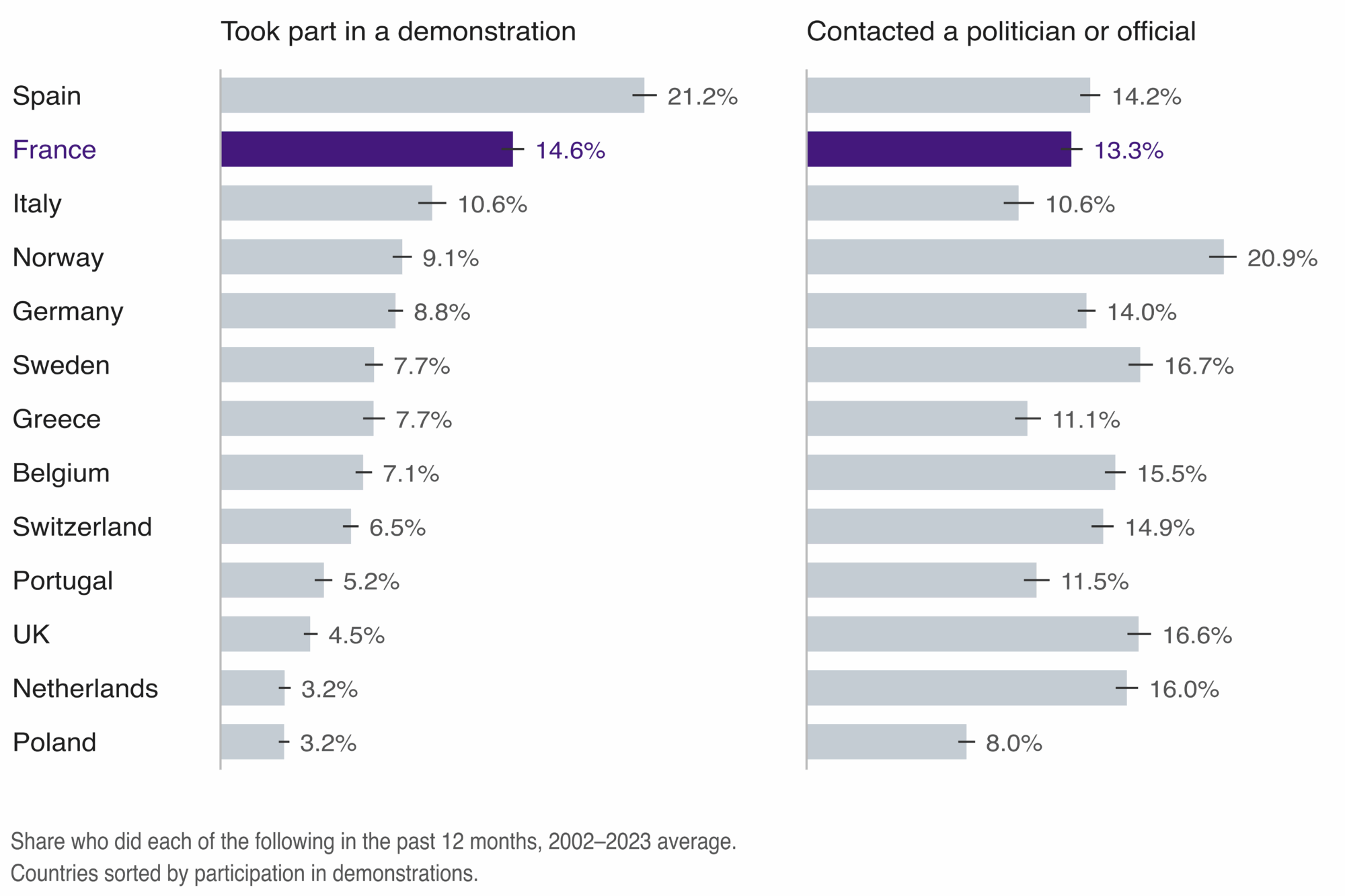
On average, about 15% of French respondents say they took part in a demonstration in the previous year. That is twice the level of most of north-western Europe and more than three times the level in the UK (4.5%) or the Netherlands (3%). Only Spain, at 21%, is higher. France also ranks high on boycotts and on wearing political badges or stickers. Contrast this with more institutional channels. Only about 13% of French respondents had contacted a politician or government official. That puts France 9th out of 13, behind every north-western European country, and well behind Norway, where a fifth of the population does so. This has been a stable feature of French political life for as long as the survey has existed.
Protest is a steady habit, not a recent outburst
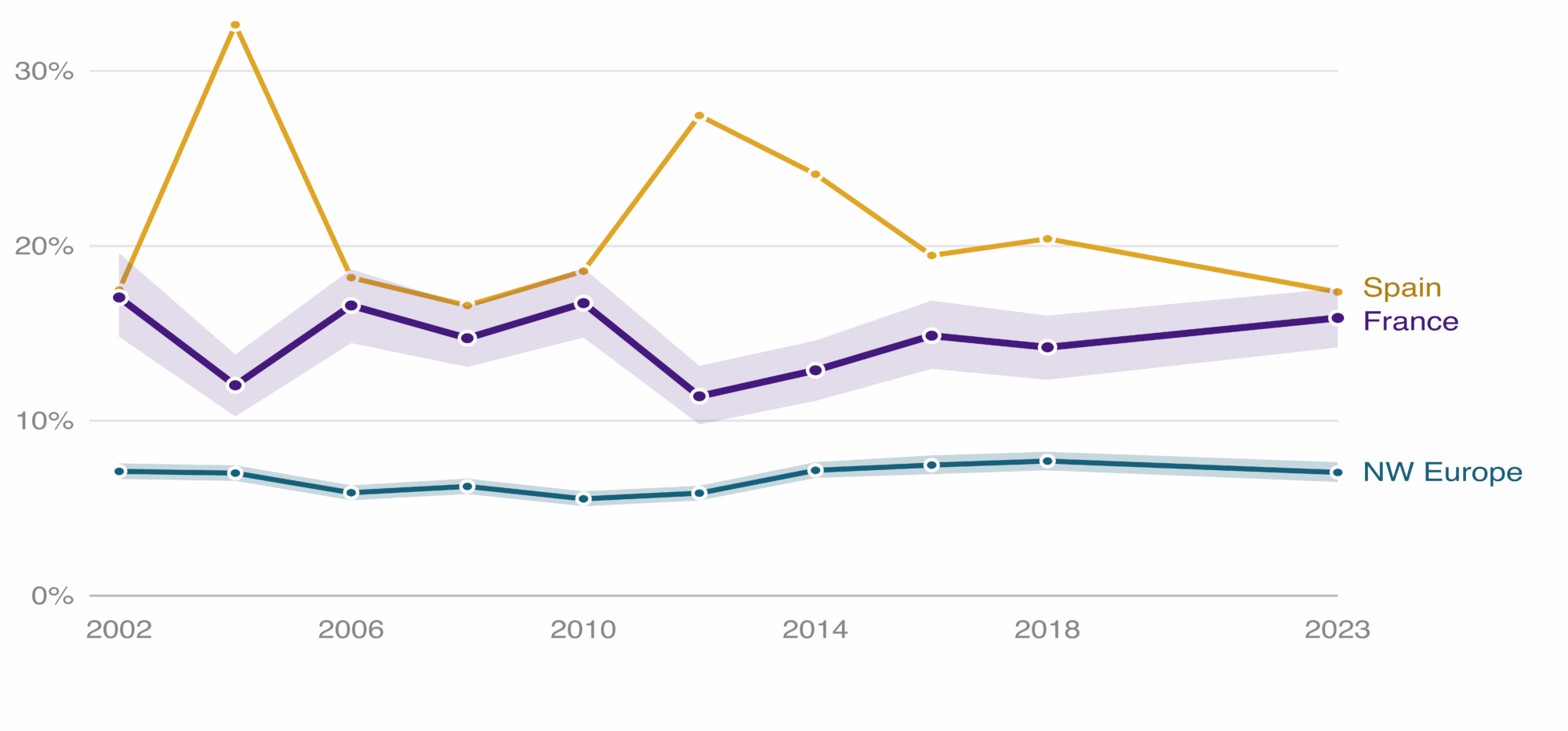
This partly reflects the distance between the French political class and the people it governs. That distance comes from a tradition of elitism, the grandes Ecoles and early social selection, which produces a governing class that looks and sounds quite different from the population. Elsewhere in Northwestern Europe, the gap between the political “bubble” and everyone else seems much smaller, and talking to your representative feels like a reasonable thing to do. In France, it often doesn’t.
To understand the protests, besides the specifics of the issues that the protesters are targeting, there is this broader context. On one side is a structural dissatisfaction with life, politics and society that is historically and culturally rooted. On the other is a deeply ingrained tradition of protest.
On blaming it on immigration: Senik’s research, if anything, suggests the opposite causal arrow: immigrants arrive in France no less happy than they would be elsewhere, and become gloomier as they become more French. More fundamentally, the idea that the French needed to import a taste for revolt is very stupid. This is a country that founded its Republic by storming a prison and guillotining its king, and it has staged revolutions in 1830, 1848 and 1871. Then came May 1968 and, more recently, the 2005 urban riots, protests against pension reforms in 1995 and 2013, more recently the gilets jaunes. When French people take to the streets, they are not being influenced by anybody.
Note: This article was first published in Alexandre Afonso’s Political Economy Newsletter.
Picture: Jules* — Own work, CC BY-SA 4.0, https://commons.wikimedia.org/w/index.php?curid=202018962

