


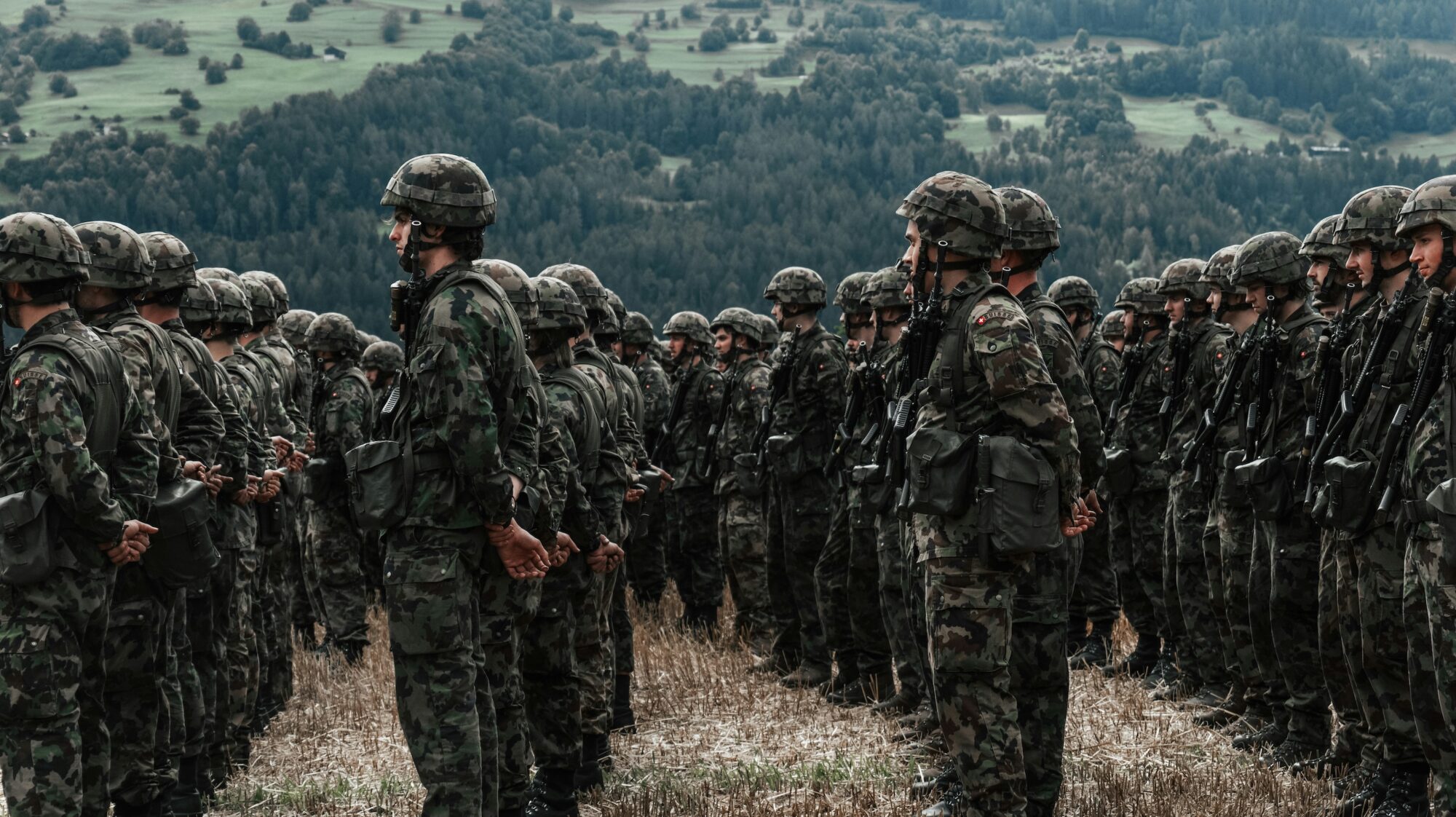
New challenges require new responses. With the Russian full-scale invasion going on for the fourth year in Ukraine, continued Russian provocations against NATO states, expanding hybrid threats and uncertainty in the transatlantic partnership in the Trump era, European countries are investing more heavily in their own militaries and tightening security cooperation with like-minded partners in Europe. Switzerland can no longer assume that old frameworks will be sufficient in such a rapidly evolving threat environment. Therefore, one can ask: what place does Switzerland have within these new security developments on the European continent and is it a reliable security partner?
Despite Switzerland neither being a member of the EU nor of NATO, it maintains close and very crucial cooperation with both institutions: most notably through Schengen and Dublin, participation in key bilateral agreements and involvement in selected EU research and mobility programmes such as Horizon. Furthermore, the Swiss Armed Forces often participate in a multitude of NATO crisis management and military exercises such as the recent Tiger Meet that included militaries of 12 other countries and contributes to interoperability initiatives via its NATO partnership programme PIAG[1][2].
The Russian full-scale invasion of Ukraine in 2022 and uncertainty of US security commitments to Europe under Trump has accelerated initiatives not only regarding EU defence coordination but also renewed investment in collective resilience. More specifically, the EU is now seeking to strengthen its mutual defence, aiming for example to boost interoperability and military mobility among member states underlining the shift toward deeper collective defence within Europe.[3] The UK, that left the EU in 2020, has become a core partner for the EU in these new security initiatives. Switzerland may also need to engage more actively in cooperative security arrangements in Europe.
While neutrality remains a central element of Swiss foreign policy, one needs to admit that the country’s security has also long benefited from a stable neighbourhood of EU and NATO member states. Despite 87% of the Swiss population supporting its neutral stance (a 10% drop since the last year), Swiss neutrality remains notoriously difficult to define.[4] In response to the war, the Federal Department of Foreign Affairs has emphasised the distinction between the “law of neutrality,” which stipulates that Switzerland cannot provide military support to parties in an armed conflict, and the “policy of neutrality,” which offers more discretion, leaving essential decisions up to the Federal Council to determine which measures are compatible with its neutrality. This and the newly coined term of “cooperative neutrality” by Foreign Minister Ignazio Cassis continues to be at the core of heated debates in Switzerland. Counterintuitively, 53% of Swiss prefer closer cooperation with NATO, while 32% support even the membership.[1]
Nonetheless, it needs to be highlighted that Switzerland has already been aligning itself with Europe on several fronts: it joined the EU’s sanctions against Russia, froze Russian assets, and has provided substantial support to Ukrainian refugees as well as financial assistance to Ukraine, which arguably underlines Switzerland’s allegiance to its European partners. In this context, the Swiss position in other regards is not easy to explain: Not only are joint exercises with NATO met with heavy criticism in the country, the continued ban on the re-export of Swiss-made military equipment to Ukraine, based on neutrality, has also alienated European partners.[2] In this context, it will be an interesting debate in the coming weeks: on 2 December 2025, the Swiss Parliament approved an easing of the War Material Export Act, declaring a strengthening of the domestic defence industry as the main goal. The issue of neutrality, however, was highly controversial during the debates: the centre-right majority in Parliament argues that this relaxation does not undermine the principles of neutrality, especially since weapons still cannot be exported directly to conflict zones. However, countries that have purchased Swiss armaments would in future be allowed to pass them on to third states. Left-wing parties fiercely opposed this change.[3] The future will show how this relaxation will develop.
With regular Russian provocations, including Russian drones and planes entering NATO countries, a ghost of a bigger war in Europe is in the air. If war reaches Swiss borders, how would the country react? Swiss air defence is considered rather weak and it is possible that it would not be able to protect the population from air attacks.[4] Yet, Switzerland is the only country in the world that has enough bunkers for its whole population. Would quick membership in NATO make sense then or would Switzerland be able to defend itself? How could a neutral country justify such a decision?
At the moment, it is undeniable that the emergence of new forms of warfare as well as the changing security landscape and formation of new alliances and partnerships in Europe will shake up Swiss security policy[5]. The question therefore remains to what extent Switzerland can rely on its traditional approaches and whether a sincere rapprochement to the EU and NATO – without necessarily joining neither of them – is a valid option. For instance, re-export of Swiss weapon would benefit Swiss producers, and turn the country into a more reliable partner in Europe. More joint military exercises, but in particular closer cooperation in preventing and fighting hybrid and cyber threats, would be also beneficial for both sides. Swiss current cooperation with the EU and NATO signal allegiance and alignment with European interests. The unclear and occasional miscommunication interpretation of neutrality, however, render Switzerland rather unpredictable in times of crisis.
References
[1] VBS. Medienmitteilung. 17 June 2025. https://www.vbs.admin.ch/de/studie-sicherheit-2025 (accessed November 26, 2025).
[2] Washington, Oliver. Neue Neutralitätsdefinition. 24. May 2022. https://www.srf.ch/news/schweiz/neue-neutralitaetsdefinition-kooperative-neutralitaet-cassis-ueberrascht-mit-neuem-begriff (Zugriff am 26. November 2025).
[3] Burkhardt, Philipp. srf.ch. 02. Dezember 2025. https://www.srf.ch/news/schweiz/waffen-made-in-switzerland-parlament-oeffnet-tuer-fuer-kriegsmaterialexporte-ins-ausland (Zugriff am 3. Dezember 2025).
[4] Rigendinger, Balz. Seven weaknesses in ‘Fortress Switzerland’, https://www.swissinfo.ch/eng/swiss-politics/seven-weaknesses-in-fortress-switzerland/88890711. (accessed November 27, 2025).
[5] Centre, National Cyber Security. Current Figures. 2025. https://www.ncsc.admin.ch/ncsc/en/home/aktuell/aktuelle-zahlen.html (Zugriff am 26. November 2025)
[1] swissinfo. The Swiss want more cooperation with NATO. 18. June 2025. https://www.swissinfo.ch/eng/foreign-affairs/the-swiss-want-more-nato-cooperation/89537369#:~:text=Broad%20support%20for%20conscription%20and%20increased%20defence,60%25%20continue%20to%20support%20the%20militia%20system (Zugriff am 26. November 2025)
[2] Armee, Schweizer. Gruppe Verteidigung. 4 November 2025. https://www.vtg.admin.ch/de/newnsb/H5y0VTMF0CUHEsUxKfwHw (accessed November 26, 2025).
[3] Tidey, Alice. euronews. 15. May 2025. https://www.euronews.com/my-europe/2025/05/15/brussels-looking-to-beef-up-the-eus-collective-defence-clause (Zugriff am 26. November 2025).
[4] VBS. Medienmitteilung. 17 June 2025. https://www.vbs.admin.ch/de/studie-sicherheit-2025 (accessed November 26, 2025).
Image: unsplash.com

