


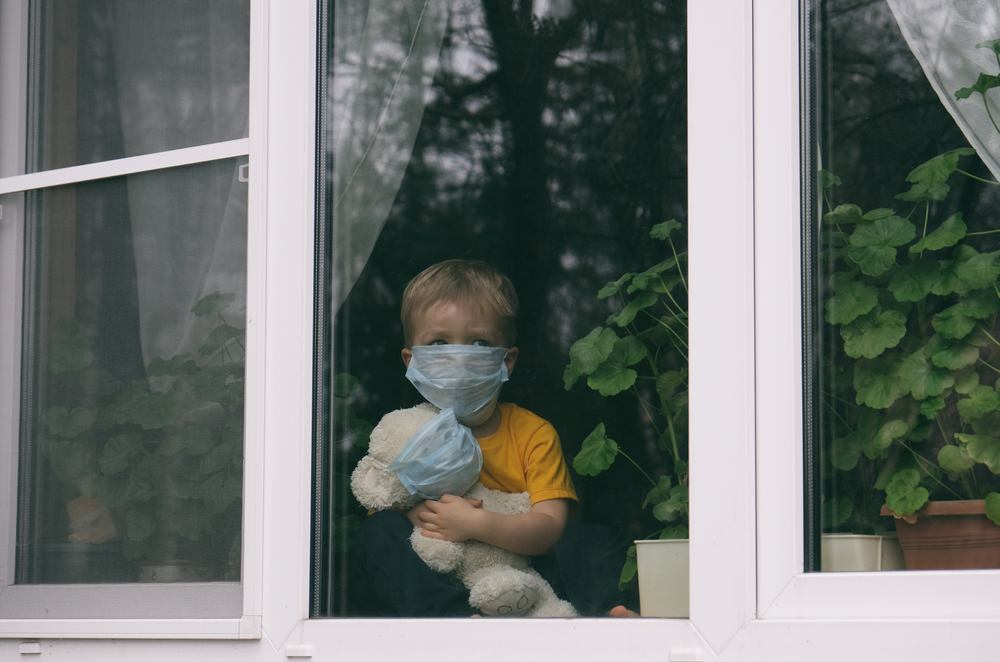
Experts feared that COVID-19 would lead to an increase in domestic violence due to the lockdowns and the stress associated with them. This “pandemic within the pandemic” was not clearly evident in the official statistics, yet the health crisis has highlighted the vulnerability of social protection systems in relation to domestic violence and child welfare in Switzerland.

“[Parents] are to raise the child without the use of violence.” On 9 September 2025, the Council of States followed the National Council and agreed to incorporate the principle of parenting without violence, “corporal punishment and other forms of degrading treatment”, into the Swiss Civil Code. It has been a long road to get to this stage: A first parliamentary motion for non-violent parenting had already been submitted by the Legal Affairs Committee of the National Council in 1996, so almost thirty years ago.
The COVID-19 pandemic likely contributed to this positive outcome, notes Tim Tausendfreund of the Zurich University of Applied Sciences (ZHAW). The researcher is leading the project “Child protection – Covid-19 and beyond”, as part of the Swiss National Research Programme “COVID-19 in Society” (NRP 80). He emphasises that the pandemic has contributed to raising issues of child welfare. The results of the vote, however, in particular highlight a societal change that has been emerging for decades: Parenting using violence is becoming less and less accepted worldwide.
COVID-19 has really mobilised those involved in child protection. Tausendfreund emphasises that they had already warned about the risks of increased abuse during times of crisis. “It was to be expected that such a crisis would amplify many known risk factors, including workplace stress, financial worries, or the fact that people had to live in such close quarters for such an extended period of time”, states Paula Krüger of the Lucerne University of Applied Sciences. She is the lead researcher of the Domestic Violence project funded as part of the NRP 80. Numerous experts feared a “pandemic within the pandemic”, meaning a significant rise in domestic violence in addition to the health problems associated with the virus. But was there actually a “pandemic within a pandemic”?
Disentangling the data
Krüger states that a complex picture emerges from the data. The first difficulty lies in separating the development of the phenomenon under investigation – in this case, “abuse” – from the factors that influence its measurability. The media, as well as campaigns that promote non-violent parenting, have increased awareness of the phenomenon and encouraged people to seek help or raise the alarm. Increased figures in police statistics or those of social services may therefore be related to both a higher detection rate of such cases as well as an increase in their frequency. A report from November 2020 highlights this fact.
The research group led by Paula Krüger analyses data from services providing help for people affected by violence and from hospitals, as well as data from police crime statistics. Since 2020, she has been regularly questioning around 1,500 to 1,750 people about domestic violence and known risk factors such as stress or parental burnout. She also conducts interviews with people who are victims of domestic violence or who have perpetrated domestic violence themselves.
Different effects during different phases
“While some official statistics do not show a significant impact of the pandemic on the number of cases of domestic violence, it is possible that these statistics lack the basis for data, as they only analyse the prevalence of domestic violence from the past twelve months”, she explains. “In our research project, we also asked families about domestic violence during the last four weeks.” This detailed analysis makes it possible to distinguish the various phases of the pandemic. The lockdown in the spring of 2020 was indeed a shock for most people, but many assumed that it wouldn’t last long, and this helped reduce stress levels. The second phase of restrictions from autumn 2020 to spring 2021 led to more uncertainty and thus to more stress, an important risk factor for domestic violence and neglectful parenting, Paula Krüger states.
It has often been said that wealthier circles were better able to cope with the difficulties of the pandemic – such as working from home or home schooling – and that COVID-19 exacerbated the problems of economically disadvantaged or socially isolated people in particular. But violence is a complex matter and affects all social classes, explains Paula Krüger: “In conversation, a financially independent woman confided in us that it took her a long time to realise that she was experiencing domestic violence. She couldn’t imagine being affected herself, as she associated domestic violence with poverty.”
There is not only physical abuse, but also psychological abuse, the researcher clarifies: Many parents still believe it’s okay not to speak to their child for days on end. She reminds us that children not only suffer from violence but also from neglect, especially when their basic needs such as food, safety, affection, or contact with other children are not met. “Because many parents were stressed and children were isolated, COVID-19 also had a negative impact in this area”, Tim Tausendfreund of ZHAW adds.
Do not fly without radar
Like every major crisis, COVID-19 was also a stress test that revealed both the vulnerability of certain people as well as that of the system that was set up to protect them. “Such an event often acts like a magnifying glass, directing our attention to phenomena that we were actually already aware of”, Tim Tausendfreund continues. “Sometimes it also reveals things that were not so visible before.” “In the case of the pandemic, this included the increased vulnerability of certain individuals, but also the complexity and the weaknesses of the child protection system in Switzerland.”
This is a complex matter that involves different sectors. Family members, neighbours, schools, paediatricians, hospitals, or even sports clubs can be the first to raise the alarm when there is suspicion of abuse. If necessary, the police, Child and Adult Protection Services, or the social services can then intervene.
Shaped as it is by various stakeholders, is this system crisis-proof? This is the central question that Tim Tausendfreund and his team are addressing within the framework of the NRP 80 project “Child protection – Covid-19 and beyond.” The pandemic has shown how dependent the system is on those at the beginning of the process, the ones who are usually the first to recognise the cases of abuse, the researcher explains. First and foremost, these are the schools, which were closed during the pandemic, those providing extracurricular activities, which were not allowed to take place during the crisis, and also hospitals, which could not examine as many children as usual, as they had to focus on the most urgent operations. “The system in place to protect children had not fully anticipated the consequences of the lockdown and school closures. For a while, the system had lost important points of contact with children. We need to increase the robustness of the system for times of crisis, because we cannot afford to fly without this radar again when we face the next crisis”, Tausendfreund emphasises. Regula Bernhard Hug, Director of Child Protection Switzerland, confirms this sentiment: “A four-year-old child does not call the police himself. He relies on an adult to do so.”
Listening to the children
Tim Tausendfreund emphasises how important it is to train people who are in contact with children, especially to break down barriers that might prevent them from raising the alarm in cases of suspected abuse. “People often associate abuse with the intervention of the Child and Adult Protection Services and the fear that the parents could lose custody of their child. However, such measures are the exception.” In fact, the system is required to react in an appropriate, complementary manner that supports families. It is about taking the least intrusive measures. This should be appropriate to the specific situation and support parents, not replace them.
Sharing information leaflets at a sports club can help, but it’s not enough: “A child will only confide in someone he trusts. The most important thing is to listen to him when he speaks to you, even if the story he is telling seems incoherent, because by listening, you can build a relationship of trust.”
It is also important to better incorporate children’s voices into scientific and academic studies, the researcher adds. In studies that address the question of how child protection services fared during the pandemic, children’s voices are often missing, as shown by a literature review conducted by his team. A further study carried out by the team that is about to be published paints a complex picture of how protection services in around twenty countries responded to child welfare issues during the pandemic. On the one hand, the study shows that people seeking help contacted telephone or online support services more frequently during this period. On the other hand, it shows a decrease in the number of cases reported to the authorities, as well as the measures taken by the social services. The figures from the healthcare sector depended heavily on the context. These results clarify that everyone involved in the system reacted differently during the crisis.
“Even the first lockdown had different effects on the number of reports”, the researcher explains. “On the one hand, the closure of schools meant that an important warning system was no longer in place. On the other hand, neighbours who normally would never have been home during the day might now have had their suspicions and passed this information on.”
Incomplete data
There is another issue with the complexity of the child protection system in Switzerland: “The data we use to track the development of the situation is still incomplete and is collected by various different agencies”, says Regula Bernhard Hug of Child Protection Switzerland. “We still lack an overall picture.” For her, the incorporation of non-violent parenting into the Civil Code, as decided on in September 2025, has particularly symbolic significance: “It sends a strong signal to parents, but is also a solid argument that can be used by specialists working in this area, such as paediatricians, psychologists, teachers, or social workers. Now they can all say without hesitation: ‘This is not normal.’” The new law also has a very tangible impact on the ground: The cantons must take measures to ensure non-violent parenting, in particular by providing support services to parents and children.
References:
NRP 80, research project ‘Child protection during and after COVID-19’
NRP 80, research project ‘Domestic Violence’

