Citizens’ initiatives in Europe: Trust in the people’s judgement and trust in institutions
Daniel Moeckli
17th November 2026

Direct democracy relies on mutual trust between the people and state institutions. This is evident from the way in which citizens’ initiatives are regulated and used in Europe.

The number of citizen-initiated mechanisms of direct democracy has risen considerably over the last few decades. At least in Europe, these mechanisms are being used more and more often.
Fig. 1: Citizens’ initiatives launched per year across European countries

There is empirical evidence that this rise of direct democracy is driven by declining trust in representative institutions. Direct-democratic instruments make it possible to bypass the parliamentary process, which is decried as being controlled by political parties and lobbies.
Strengthening direct democracy could reinforce political trust: Subnational data from Switzerland shows that cantons with stronger direct-democratic rights tend to display higher levels of trust in political institutions overall. This could be explained by the fact that direct-democratic instruments allow citizens to influence and control their political agents.
Bottom-up direct democracy
However, this is only true for those instruments that work bottom-up, allowing citizens to initiate the process. Government-initiated referendums, on the other hand, are associated with populist manipulation and tend to produce more polarising and trust-damaging outcomes.
Fig. 2: Typology of direct-democratic instruments
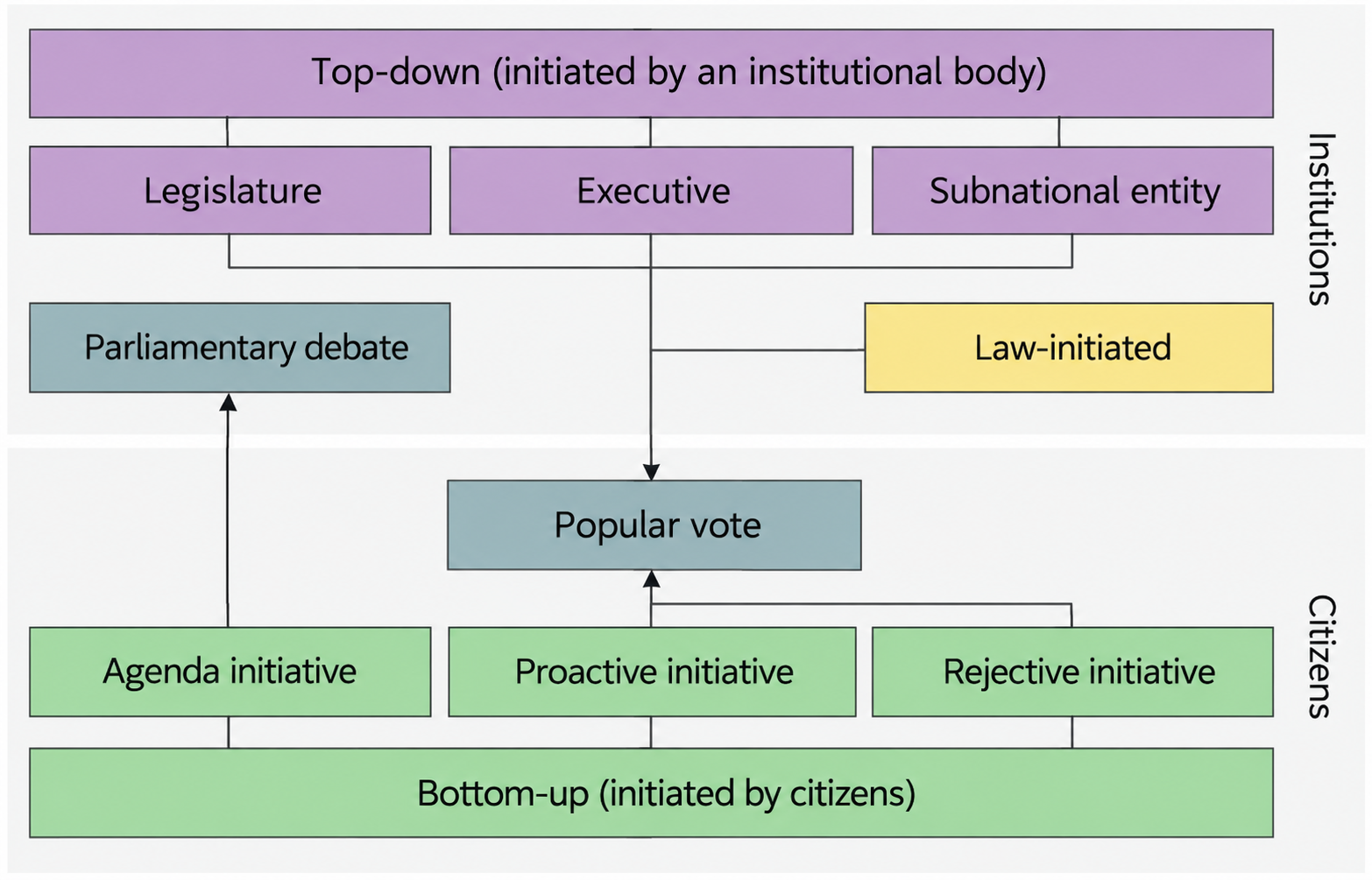
These two primary types of instruments have very different historical and philosophical roots. Top-down initiated referendums go back to the 16th century when French kings started to consult the people on the sovereignty over territories.
Bottom-up instruments emerged much later, in the 19th century; they have their historical roots in grassroots democratic movements that mistrusted the representative system and pushed for more direct forms of political participation. These mechanisms include the proactive initiative, which allows voters to initiate a referendum and formulate its topic; this instrument exists in 20 out of the 46 Council of Europe member states. The rejective initiative, which exists in 9 European states, allows voters to initiate a referendum that is aimed at preventing laws from being passed. The agenda initiative, finally, allows voters to place an issue on the agenda of parliament, without directly leading to a referendum; it exists in 28 states in Europe.
Today, 33 Council of Europe states (more than 70% of them) have at least one bottom-up instrument of direct democracy. In total, 57 such instruments exist across Europe.
Citizens will use these instruments if they trust that they allow them to exert some influence on policymaking. Whether that is indeed the case depends on a myriad of factors and is difficult to measure.
If the success of initiatives is measured by the rate of acceptance in the popular vote, as the V-Dem index does, the result is an impressive success rate of 26%. For the Hungarian proactive initiative, for example, this index indicates a success rate of 60% because 3 out of 5 initiatives voted on were accepted in the referendum.
Fig. 3: Success rates of direct-democratic instruments according to the V-Dem index
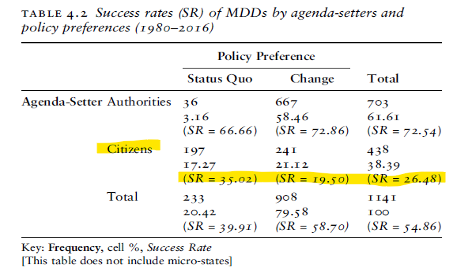
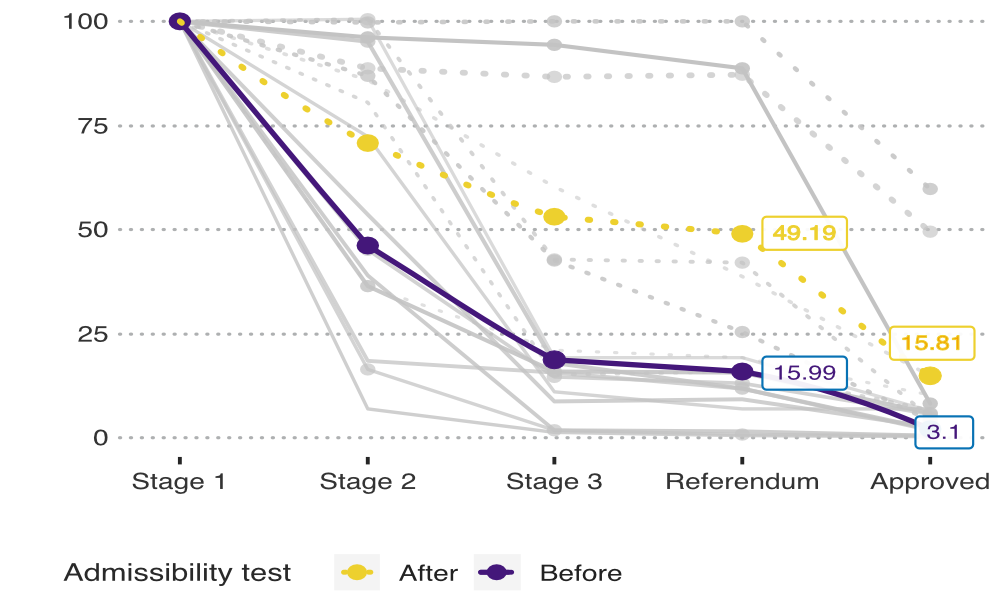
However, just looking at the vote stage produces a distorted picture. Initiatives must go through several stages before they reach the popular vote, including an admissibility test and a signature collection. To be meaningful, an indicator of success needs to be based on data that takes account of the whole process. We have collected that data and produced such a metric, which shows that the probability of launching a successful initiative in Europe is in fact much lower: 3% or 16%, depending on when the admissibility test occurs. For Hungary, we identified 1’937 initiatives that citizens started between 1990 and 2020. Of these, only three were approved. All the others failed at a previous stage of the process; the vast majority of them were deemed inadmissible. So, the success rate is in fact close to zero (0.15%).
Fig. 4: Success rates of bottom-up instruments of direct democracy according to D. Moeckli et al.
Trust in the people’s judgement
Admissibility is therefore a key issue, and one that brings us to the authorities’ trust in the people’s judgement.
What is meant with admissibility? In a representative system of democracy, parliament is, as a general rule, allowed to debate, and decide upon, any issue falling within its competence. Measures passed by parliament can normally only be reviewed, if at all, after their adoption.
In contrast, when it comes to bottom-up instruments of direct democracy, virtually all European states preclude certain issues from the very start: initiatives are reviewed before a popular vote may be held, often even before the collection of signatures may begin. Admissibility requirements have been imposed on 55 of the 57 bottom-up instruments in Europe.
A common requirement is, for example, that initiative proposals must be clear and precise. In addition, many states exclude certain subject matters from decision-making by the people.
Fig. 5: Prohibited subject matters for bottom-up instruments of direct democracy
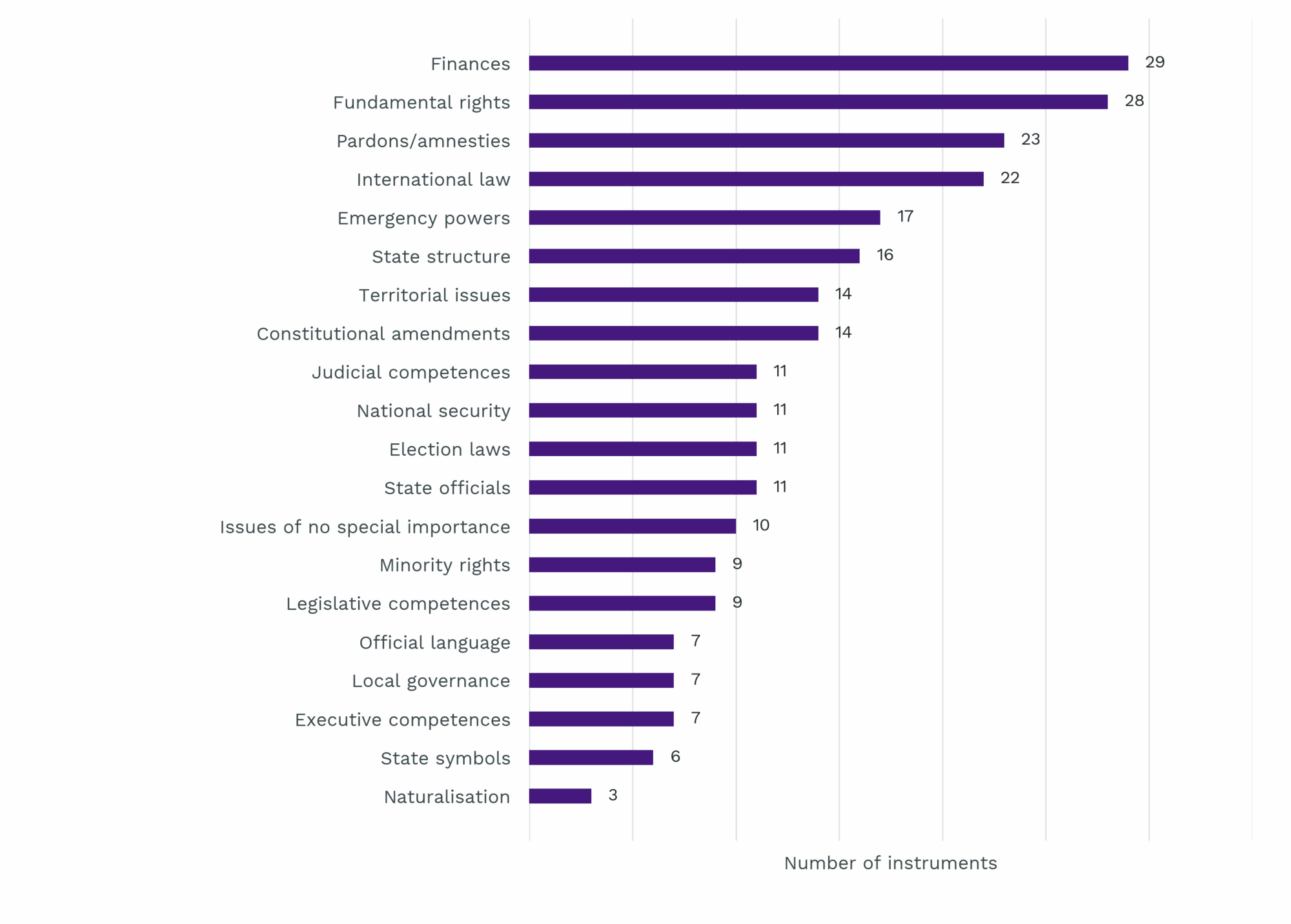
At the top of the list of prohibited subject matters are financial questions. Since almost any citizens’ initiative will have some financial implications, this requirement has been used in many states to invalidate all sorts of proposals. In quite a few states also national security matters are beyond citizens’ reach.
These are just two examples of topic prohibitions that quite evidently reflect a distrust of the judgment of the people. When, in 1922, the subject matter prohibitions were introduced in Latvia, the expectation was that, ‘as culture spreads and civic consciousness strengthens’, they could be gradually removed. In fact, however, they have been left in place until today.
Trust in institutions
Who is entrusted with deciding whether a given initiative complies with the existing admissibility requirements?
Even though citizens’ initiatives are used to promote or oppose a legislative proposal, the point of the admissibility procedure is not to review the desirability of that proposal but rather its conformity with the admissibility requirements as they are defined in law. Thus, admissibility is a legal question. As such, it should be decided by a body that has legal expertise and is impartial.
In fact, however, in most states the admissibility of initiatives is reviewed by parliament – a political body and exactly that body that initiators normally try to circumvent or to force into action.
Nevertheless, simply entrusting courts instead of parliament with reviewing admissibility will not do the trick as, again, the example of Hungary shows. The Hungarian proactive initiative is subjected to an elaborate system of admissibility requirements. Compliance with these requirements is reviewed by the National Election Commission, the Curia (the Supreme Court) and the Constitutional Court – institutions with legal expertise that, in theory, are impartial. However, the Hungarian courts are dominated by the governing coalition. As a consequence, they apply the admissibility requirements, which are already strict on paper, in a way that has made it virtually impossible for citizens to draft an initiative that could take the admissibility hurdle.
For example, the Curia held that an initiative that demanded that all shops should be closed on Sundays was not sufficiently clear because voters would not be able to foresee all the consequences its approval would bring about to everyday life. Similarly, several initiatives aimed at allowing the Central European University to continue operating in Hungary were all declared inadmissible, one because it was too specific, others because they were too general.
In stark contrast, the courts use a very lenient approach when it comes to top-down referendums. They allowed both referendums initiated by Prime Minister Orban to go ahead even though they arguably failed to meet the legal requirements.
The result is that only 6.66% of all initiatives launched pass the admissibility test, 0.77% then collect sufficient signatures, 0.26% reach the referendum, in which 0.15% are approved.
Fig. 6: Number of successful initiatives in Hungary from 1990 to 2020
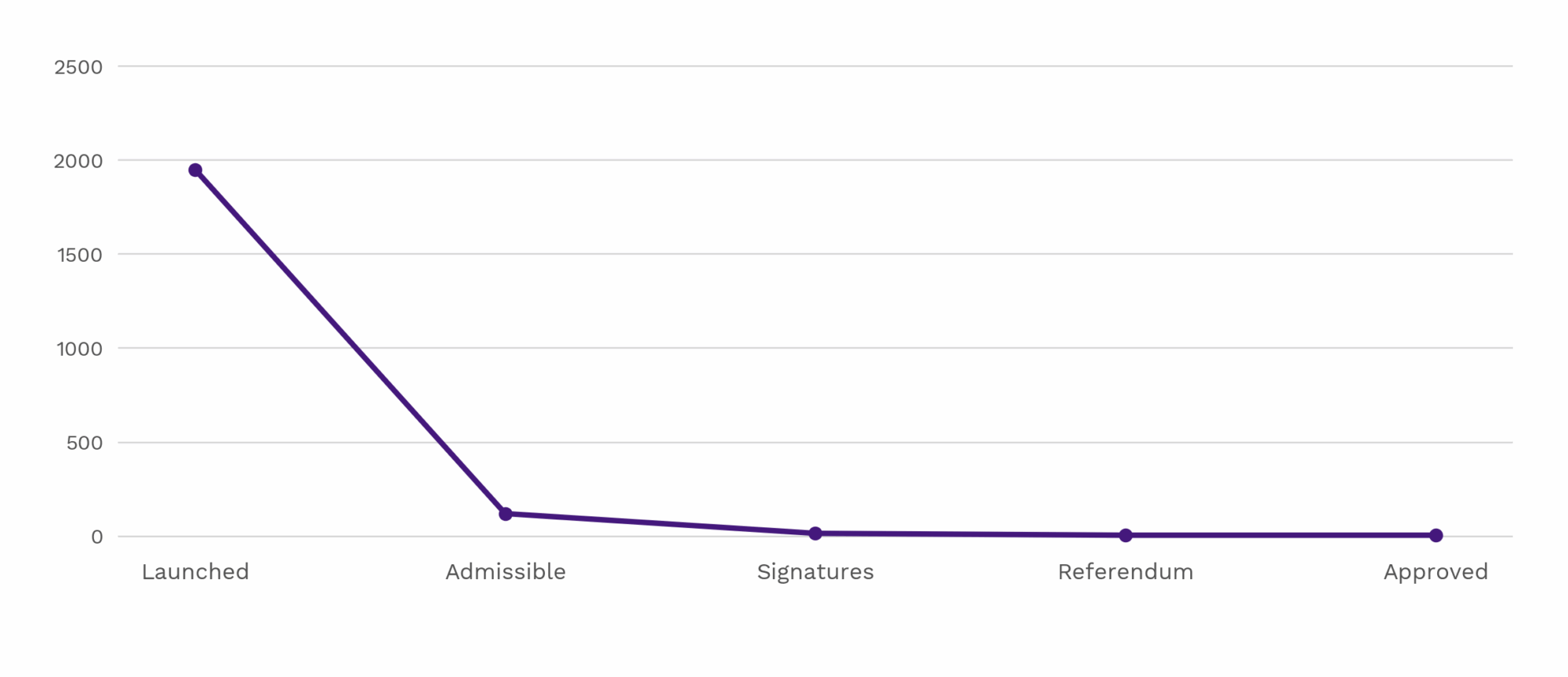
The last time a proactive initiative led to a referendum was in 2008, so before Fidesz came to power.
This demonstrates that entrusting courts with the admissibility check is no guarantee that political considerations will play no role in the decision.
Conclusion: Bottom-up direct democracy relies on trust
The availability of bottom-up instruments of direct democracy may strengthen political trust by increasing citizens’ perception that representative institutions can be controlled and by incentivizing institutions to act trustworthily
But direct democracy itself relies on trust. Institutions need to trust citizens: that they are competent enough to decide on policy issues, including important ones. Citizens, in turn, need to be able to trust institutions: that they will process their initiatives according to the established rules and that their proposals will have an impact on policies.
If this trust erodes, citizens will stop using mechanisms of direct democracy. This is what we may see in Hungary where the number of citizens’ initiatives has been declining since Orban returned to power and courts began to be packed. And we can also see it in places where this trust probably never really existed in the first place: States such as Azerbaijan, Montenegro or Serbia all have, on paper, bottom-up instruments but they are hardly ever used.
Without trust, there cannot be any direct-democratic practice.
This contribution is based on Daniel Moeckli’s presentation at the Aarauer Demokratietage on 12 March 2026.
References
Altman, Citizenship and Contemporary Direct Democracy(CUP, 2019), https://doi.org/10.1017/9781108634397
Kuhn & B. Torgler, ‘Empowering the Principal: How Direct Democracy Shapes Trust in Institutions’, BITA Working Paper No. 14 (2024)
Moeckli, F. Mendez, M. Labud, N. Reimann, ‘Mapping the European Landscape of Citizens’ Initiatives’, (2025) 73 Political Studies, doi.org/10.1177/00323217251334530
Moeckli, ‘Beyond the Reach of the People? Admissibility Requirements and Procedures for Citizens’ Initiatives in Comparative Perspective’, (2025) 21 European Constitutional Law Review 230, doi.org/10.1017/S1574019625000100
Ouattara & T. Van Der Meer, ‘Distrusting democrats: A panel study into the effects of structurally low and declining political trust on citizens’ support for democratic reform’, (2023) 62 European Journal of Political Research 1101, https://onlinelibrary.wiley.com/doi/10.1111/1475-6765.12561
Image: unsplash.com