NGOs helped 1.7 million people during the pandemic
Adrian Ritter
8th July 2026
From people losing their jobs to social venues being forced to close periodically, the pandemic left many in financial and emotional distress. In addition to state support, help from civil society and organisations played an important role in alleviating that distress. This is why NGOs should be more closely involved in the prevention and management of crises in future.
“The Covid-19 pandemic was more than just a health crisis; it was the greatest economic crisis in recent history,” says Oliver Hümbelin, a professor specialising in poverty and livelihood security at Bern University of Applied Sciences. He is one of a number of researchers who studied the social effects of the pandemic as part of NRP 80, a programme which examined a number of questions: Did the pandemic increase poverty and social inequality in Switzerland? What role did the state and civil society play in managing the crisis? In this blog post, three researchers outline some of the insights they and their colleagues have gained through their studies.
NRP 80 projects such as “Poverty and social security” and “Frontline work in humanitarian crises” found that the pandemic led to significant losses of income for some sections of the population. Those particularly affected included people on low wages and those in precarious working and living conditions – disproportionately migrants, women and younger workers.
Preventing unemployment
The state tried to mitigate the consequences. First and foremost, short-time compensation helped to keep Covid-19 from escalating into an unemployment crisis. During the pandemic, under the short-time working scheme, wages for those with lower incomes were compensated in full rather than at the usual 80 per cent. The eligibility period for receiving unemployment benefits was also extended. In addition, income replacement benefits for the self-employed and Covid-19 loans for businesses helped preserve jobs and offset declining incomes.
The social security systems were effective, as the NRP 80 research shows. While the unemployment rate did indeed increase in the first, most economically challenging year of the pandemic, to an average of 3.1 per cent (2019: 2.3 per cent), it remained comparatively low. At the same time, some 1.3 million employed persons were protected under the short-time working scheme in April 2020. As a result, the social assistance and poverty rates held steady. However, there were two caveats to this success. Firstly, not everyone had access to the state security systems. Secondly, the pandemic measures did not come into effect immediately due to the political processes involved.
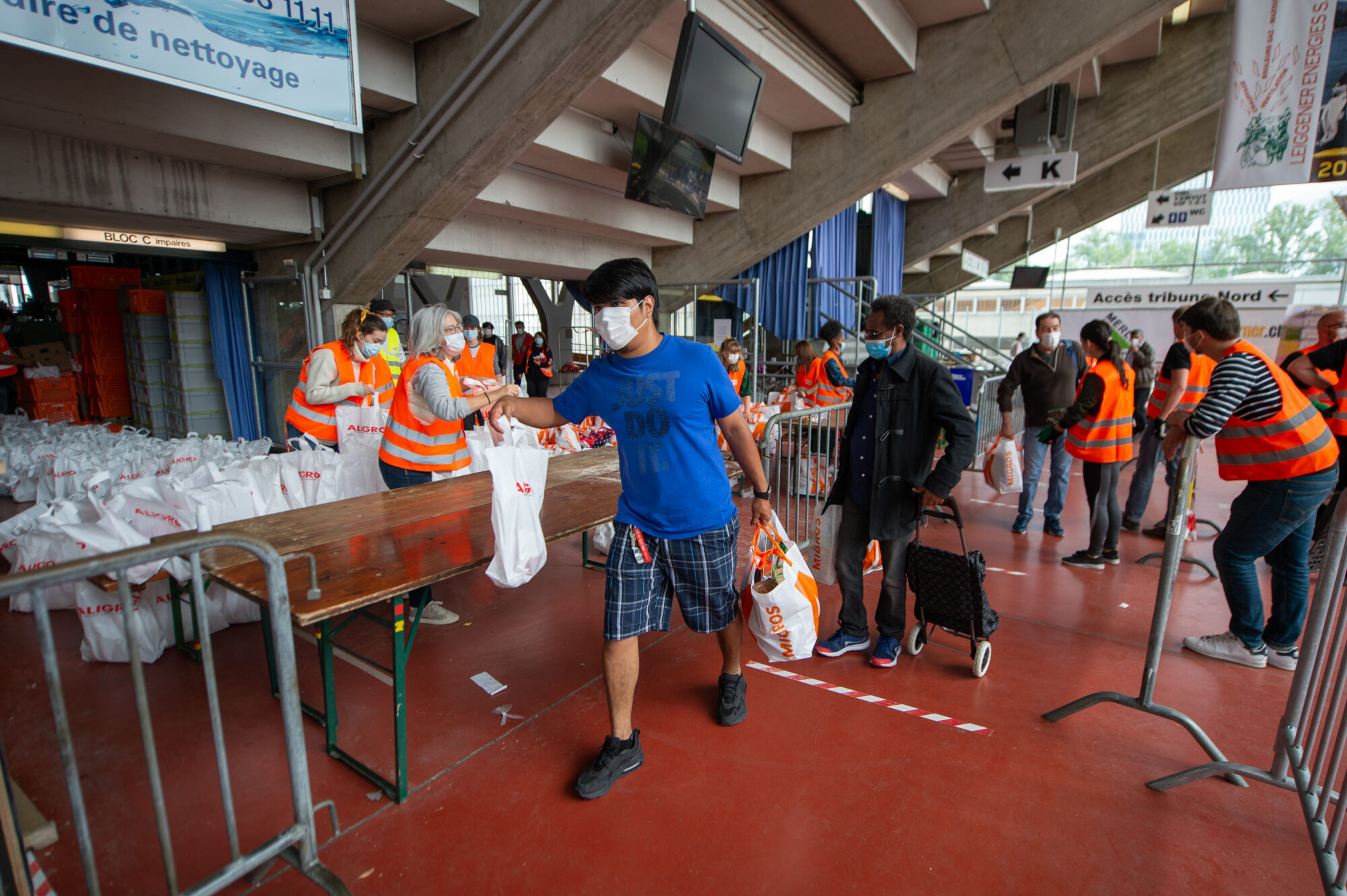
The assistance from civil-society initiatives was therefore crucial during the first phase of the pandemic, and overall, particularly for those with limited or no access to state support. Hundreds of organisations such as Caritas, the Red Cross and the Salvation Army were important points of contact for many people – according to estimates, they helped around 1.7 million people in Switzerland during the pandemic. They offered counselling, provided financial and other practical support and tried to help those affected by loneliness and emotional distress as best they could despite the pandemic restrictions.
Precarious conditions
“These organisations are often the first to see which people have fallen through the cracks of support structures and where new supply gaps are emerging,” explains Matthias Drilling, a professor at the ZHAW School of Social Work.
In an interview conducted as part of an NRP 80 project, an expert from a social organisation described the situation: “No one had realised just how many people were already living in highly precarious conditions before the crisis.” Even before the pandemic, the number of people not receiving social benefits – and the resulting hidden poverty – had been high. The situation had become even more acute after the revision of the Foreign Nationals and Integration Act in 2019: “People without a Swiss passport have been claiming social benefits less often since then, even though they are entitled to them,” says Rulla Sutter, a research assistant in Hümbelin’s team.
The work done by social organisations during the pandemic was very important for highly vulnerable sections of the population in particular. They were able to expand their support in part because the pandemic strengthened social cohesion. Swiss Solidarity, for example, received around CHF 43 million in donations to help alleviate the consequences of the pandemic and used the funds to support NGOs. Volunteer work also increased, for example in the form of neighbourhood support. Drilling refers to these non-governmental initiatives, whether in the form of organisations or informal networks, as “frontline work”.
“Initiatives like these help in a variety of ways,” says Sutter. “They not only provide concrete support but also help people assert their social rights when dealing with the authorities. Plus, they perform an ‘advocacy’ function that is important for democracy, highlighting social issues and bringing them to the attention of social policy-makers.”
The pandemic did place a significant additional workload on civil society initiatives, however, particularly as staff were sometimes absent due to illness or quarantine measures. Many organisations reported feelings of emotional exhaustion and being overwhelmed.
The risk of new forms of exclusion
At the same time, social initiatives had to be careful not to further exacerbate vulnerabilities during the pandemic. Certain services were digitalised in view of the health risks, which made access easier for some people seeking help but more difficult for others.
NGOs always operate in difficult circumstances. Several NRP 80 research groups have highlighted some of the paradoxes: “Organisations always have limited resources and must therefore prioritise the support they provide – at the risk of failing to meet the needs of certain people. Moreover, organisations sometimes have to collect data about people to meet reporting obligations, and this can undermine the relationship of trust,” says Sutter. No single organisation can resolve these contradictions, Sutter says, which is why it is important for there to be a variety of stakeholders: “They can complement each other. And those affected have the opportunity to choose where they feel more comfortable.”
The risk above the poverty line
Thanks to targeted support designed to keep employees in the labour market as much as possible, Switzerland fared well during the pandemic. “This should also be the goal of measures planned for future crises,” says Hümbelin. At the same time, he stresses that vulnerabilities just above the poverty line and among people with limited access to state support should be given more attention in the future: “If you only look at incomes and social assistance figures, you miss the hidden forms of economic fragility.”
To prevent this, the NRP 80 researchers agree that more needs to be done to incorporate the experience and data provided by social organisations. Sales figures in Caritas Markets and data on counselling cases are suitable as an early warning system and for monitoring purposes during crises. Preliminary work on processing such data has already been carried out as part of an NRP 80 project.
Another of the researchers’ recommendations is to get social services, NGOs and the social sciences more involved in crisis planning and crisis management. “During the pandemic, it became clear that crisis management worked better where public authorities and civil society organisations collaborate closely,” says Drilling.
The state and civil society are both needed
The researchers also agree that, whether before or during a crisis, the state and civil society are both essential. “The main support should come from the regular social insurance system,” says Hümbelin. However, the different elements of the system should be designed to be more inclusive, particularly to ensure that people can access support without fearing for their residency status.
In addition, civil society initiatives will be important in future crises to support people who fall through the cracks of the state safety net. “It is not social welfare that is the ultimate safety net, but civil society. Its initiatives are enormously important for the quality of life of many people,” says Drilling. This was also evident after the pandemic, when higher inflation continued to keep many people on the brink of poverty.
However, according to Sutter, one thing must not be forgotten: “NGOs can only provide support for a limited time due to limited resources; they can never provide such comprehensive support as social security.” These organisations also compete for funding on a day-to-day basis, which makes collaboration difficult. New forms of cooperation are therefore needed. “And the state must also help to ensure that frontline work has sufficient financial resources for its important task – and is not solely reliant on donations,” adds Drilling.
References:
- NRP 80 research project “Poverty and social security”
- NRP 80 research project “Frontline work in humanitarian crises”
- NRP 80 studies on poverty and social security
- NRP 80 studies on frontline work
- Policy brief: Crisis Management and Poverty – Lessons from the Covid-19 Pandemic
Image: Getty Images